
2006|Japanese edition
The poster was developed under MEXT supervision as an accessible gateway to genome science following the completion of the Human Genome Project.
Human Genome Map for Every Home
Human Genome Map for Every Home was released in 2006 as a learning resource supervised by Japan’s Ministry of Education, Culture, Sports, Science and Technology. Kei Kano contributed as a leader of the production team in the Life Science and Culture laboratory at Kyoto University’s Graduate School of Biostudies.
The project was more than a diagram showing the locations of genes. It brought DNA, genes, proteins, human characteristics, medicine, research and ethical, legal and social issues into one visual field, enabling people without specialist training to see relationships and begin with their own questions.

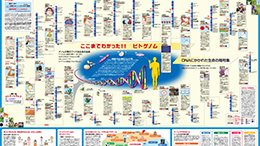
Genome science contains an enormous amount of information. Learning isolated terms can make it difficult to see how ideas connect. By arranging chromosomes and selected genes on one large surface, the poster lets readers move between details and the whole. It was also designed to be displayed in homes, schools and public learning spaces, where it could support conversation.
The poster was developed under MEXT supervision as an accessible gateway to genome science following the completion of the Human Genome Project.
An English edition was produced to enable international use. Kyoto University’s announcement lists Kei Kano and the other members of the production team.
The second edition added the four reprogramming factors used to generate induced pluripotent stem cells. MEXT currently provides the fourth edition, which updates sections on medical applications, genome editing and ELSI.
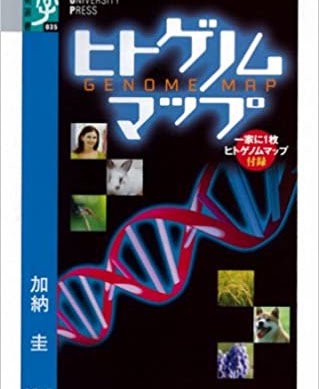
Kei Kano wrote the Japanese-language book Human Genome Map for readers who wished to go further into the basics of the genome, inheritance and evolution, protein function, frontier research, ELSI and genome literacy.
A research article also examined the potential of posters as science-communication tools: their ability to present a whole picture, their ease of distribution, their ripple effects, and their role in supporting dialogue through educators and learning programmes.
This experience continues to inform work on visualising complex science without erasing uncertainty, connecting frontier life science with ELSI, designing resources that allow learners to enter through their own questions, and creating science communication that can travel across languages and contexts.
Kano, K., Kawakami, M., Muroi, K., & Kato, K. (2009). A poster for the introduction to genome science: “Human Genome Map for Every Home.” Journal of Science Communication, 5, 133–147. https://doi.org/10.14943/34641
Kano, K. (2008). Human Genome Map [Japanese]. Kyoto University Press. https://www.kyoto-up.or.jp/books/9784876988358.html
Ministry of Education, Culture, Sports, Science and Technology. (2022). Human Genome Map for Every Home, fourth edition [Japanese]. https://www.mext.go.jp/a_menu/kagaku/week/1413572_00003.htm
Kyoto University. (2008, July 23). English edition of Human Genome Map for Every Home released [Japanese announcement]. https://www.kyoto-u.ac.jp/ja/archive/prev/news_data/h/h1/news5/2008/080723_1
Kyoto University Institute for Integrated Cell-Material Sciences. (2008, November 5). Four factors used to induce iPS cells added to the Human Genome Map [Japanese]. https://www.icems.kyoto-u.ac.jp/j/pr/2008/11/05-kanou.html